SEO workflow automation is the practice of connecting tools, scripts, and processes to handle repetitive SEO tasks—keyword research, audits, content briefs, reporting—without manual intervention at every step, freeing teams to focus on strategy and execution quality.
Most SEO teams drown in repetitive tasks: pulling rank data, auditing crawl errors, building content briefs, formatting reports. These tasks are necessary but rarely require creative judgment every single time. SEO workflow automation replaces manual repetition with connected systems that trigger, execute, and report automatically—turning a fragmented process into a repeatable growth engine. This article breaks down the architecture, benchmarks, implementation steps, and failure points you need to build one that actually works.
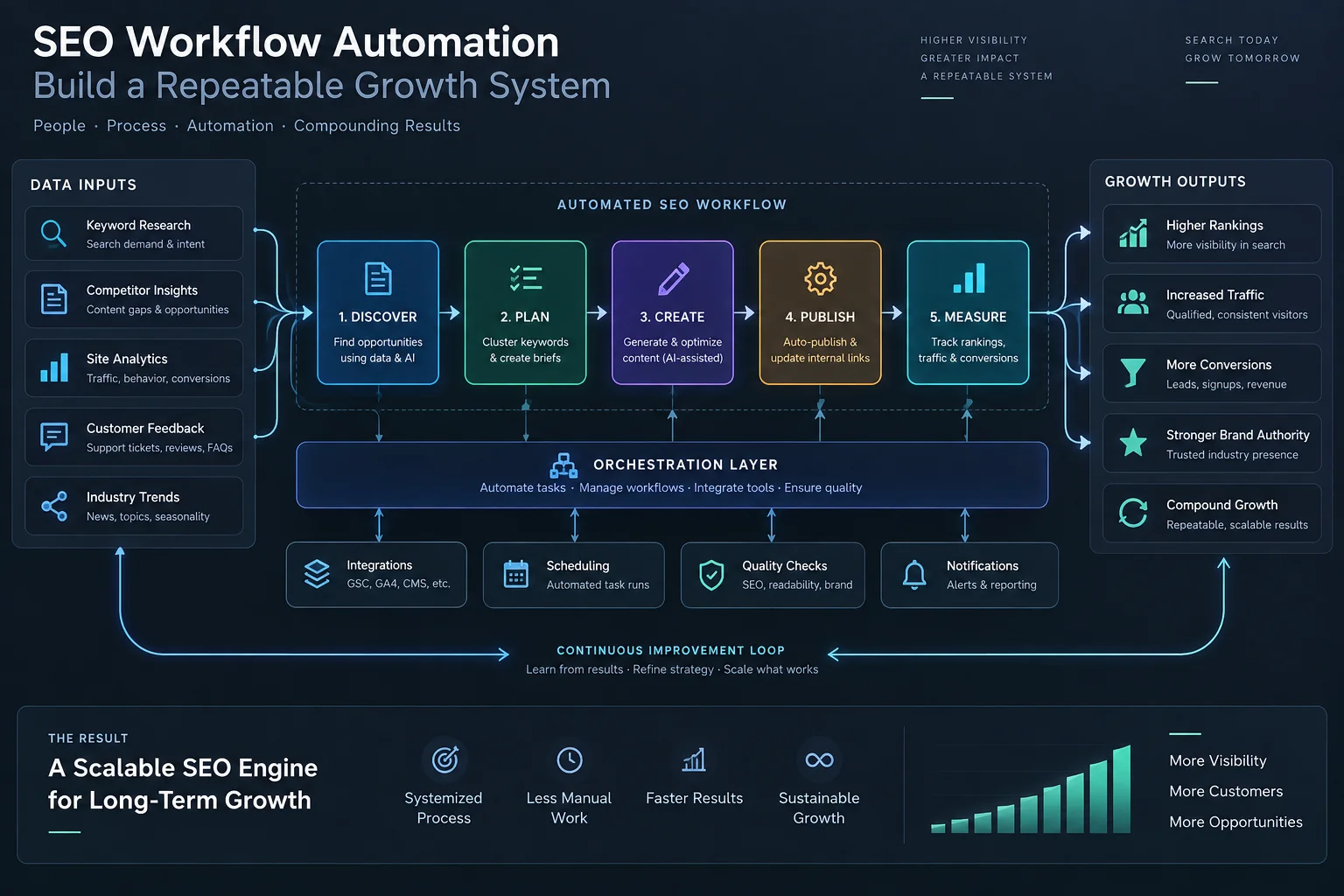
What Is SEO Workflow Automation: Definition & Core Architecture
SEO workflow automation is the structured use of software, APIs, and rule-based triggers to execute recurring SEO tasks—crawling and indexing checks, keyword research and keyword clustering, on-page content optimization, and rank tracking and SEO reporting—without manual repetition for every instance. The core architecture has three layers: data collection (crawlers, APIs, Google Search Console exports), processing logic (rules, scripts, AI models that interpret the data), and output delivery (dashboards, alerts, auto-generated briefs or reports).
A functioning system connects these layers so information flows without a human copying data between spreadsheets. For example, a technical SEO audit tool crawls your site weekly, flags new 404s or duplicate titles, and pushes those issues directly into a project management tool as tickets. Keyword research and clustering tools pull search volume and intent data, group terms into topic clusters, and feed those clusters into a content calendar automatically. The goal isn't replacing strategists—it's removing the manual labor between decision points so strategists spend time on judgment calls, not data entry.
Key Evaluation Criteria & Industry Benchmarks
Not all automation is worth building. Before investing time in a workflow, evaluate it against four criteria: frequency (how often does this task repeat), time cost (how many hours does it consume monthly), error rate (how often do manual mistakes occur), and decision complexity (does this require human judgment or just execution). Tasks with high frequency, high time cost, low decision complexity, and measurable error rates are automation priorities—think rank tracking, crawl audits, and reporting. Tasks requiring nuanced editorial judgment, like final content approval, should stay human-led even inside an automated pipeline.
Industry benchmarks help set expectations. Teams that automate rank tracking and reporting typically cut reporting time by 60-80%, according to agency case studies on automated workflows. Technical SEO audits that run on automated weekly crawls catch indexing issues 3-5x faster than quarterly manual audits, reducing the window where crawl errors suppress rankings. Content teams using automated brief generation report 30-40% faster time-to-publish because writers receive structured guidance instead of starting from a blank page. For a deeper look at building the brief layer correctly, see this SEO content brief template resource, which outlines the structural elements worth automating versus customizing per page.
Step-by-Step Implementation Framework
Step 1: Audit your current manual workflow. Document every recurring SEO task your team performs monthly—keyword research, technical audits, content optimization checks, rank tracking, reporting. List the tools used, time spent, and who owns each task. This audit reveals where manual bottlenecks exist before you automate anything.
Step 2: Prioritize by impact and frequency. Rank each task using the evaluation criteria above. Start with the highest-frequency, lowest-complexity tasks: automated rank tracking and SEO reporting almost always deliver the fastest ROI because they're purely data-pull-and-format operations. For teams needing a structured comparison of tracking platforms before committing, this guide on SEO rank tracking tools breaks down accuracy, coverage, and cost tradeoffs.
Step 3: Connect data sources. Integrate Google Search Console, your CMS, and your chosen SEO automation tools through APIs or native integrations. This is the foundation layer—without clean data flow, automated outputs will be inaccurate or incomplete. Set up scheduled exports or live API connections so crawling and indexing data updates without manual pulls.
Step 4: Build keyword research and clustering pipelines. Use automation tools to pull keyword data, filter by intent and volume, and group related terms into topic clusters automatically. This step feeds directly into content planning, so clusters should map to specific pages or content hubs rather than isolated keywords. For teams building this layer from scratch, keyword clustering for SEO provides a framework for turning clusters into topic maps that rank.
Step 5: Automate technical SEO audits. Schedule recurring crawls (weekly or biweekly depending on site size) that flag broken links, duplicate content, missing meta tags, and indexing anomalies. Route flagged issues directly into your task management system with severity tags so your team triages by priority, not by manually re-checking spreadsheets.
Step 6: Standardize on-page content optimization. Use templates and automated scoring tools to check that published content hits target keyword density, header structure, internal linking requirements, and readability thresholds before it goes live. This reduces the editorial back-and-forth that slows publishing cycles.
Step 7: Automate reporting and alerts. Connect rank tracking, traffic, and conversion data into a single dashboard that updates automatically and triggers alerts for significant ranking drops or traffic anomalies. This closes the loop—your team sees results without manually compiling data. For a complete framework on this stage, see automated SEO reporting, which covers how to convert raw metrics into decisions rather than static charts.
Step 8: Layer in AI agents for scale. Once core workflows run reliably, lean teams can deploy AI agents to handle research synthesis, content drafting support, and anomaly detection at a scale manual processes can't match. The autonomous AI SEO agent playbook offers a practical B2B approach for teams without large headcount.
Common Bottlenecks and How to Prevent Them
The most common pitfall is automating a broken process. If your keyword clustering logic is flawed or your content brief template is incomplete, automation just produces bad output faster. Audit and fix the underlying process manually first, then automate it—never automate a process you haven't validated works correctly at a small scale.
A second bottleneck is data silos. Teams often automate individual tasks (rank tracking, audits, reporting) without connecting them, creating isolated dashboards that still require manual cross-referencing. Fix this by mapping data flow before building: decide which tool is the single source of truth for each metric and ensure every other tool references it rather than duplicating data. A third issue is over-automation of judgment-heavy tasks, like final content quality review or strategic keyword prioritization. Top practitioners keep humans in the loop at decision points while automating everything around them—the research, the formatting, the distribution.
Technical debt is another recurring problem: automation scripts and integrations break when tools update their APIs or when site structure changes, and teams without monitoring don't notice until rankings drop. Build in weekly health checks on your automation pipeline itself, not just on SEO performance. Finally, teams sometimes automate without considering downstream effects, like sending too many automated outreach or notification emails that get flagged as spam—a related risk worth understanding is covered in why B2B emails land in spam, since automated reporting and alert systems often rely on email delivery that can fail silently if deliverability isn't managed.
Frequently Asked Questions
What is the single most effective way to handle SEO workflow automation?
Start with rank tracking and reporting automation since it has the highest frequency and lowest decision complexity, delivering fast, measurable time savings. Once that foundation is stable, expand into technical audits and keyword clustering before tackling content generation.
How can teams implement this framework immediately?
Begin with a one-week audit of current manual tasks, then connect Google Search Console and your rank tracker to a single dashboard this month. Use the step-by-step framework above to layer in technical audits and clustering over the following 60 days rather than attempting full automation at once.
What are the most common pitfalls and how do top practitioners avoid them?
The biggest pitfall is automating a flawed process, which scales errors instead of fixing them. Top practitioners validate each workflow manually at small scale first, then automate only after confirming accuracy and consistent output quality.
Building a repeatable SEO growth system doesn't happen overnight, but it compounds fast once the core data connections are in place. Start by auditing your current manual workflow this week, identify your highest-frequency bottleneck, and connect your first automation—rank tracking or reporting—before expanding into content and technical layers.